
Technology can be a wonderful thing, especially in orthodontics. I remember my trips to the doctor as a kid, and I always hated having impressions done of my teeth. It requires “goop” that is in a tray they shove into your mouth and have you bite on or they press it against your teeth. My gag reflex was always activated with this process, so I never cared for it. Impressions are still used today for a few things, such as retainers, splints, and bite guards, but for appliances and Invisalign, Dr. Maginnis uses the latest in digital technology…the iTero scanner.
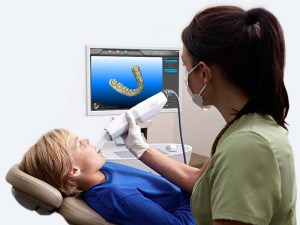
After making the decision to move forward with Invisalign, getting a digital scan of your teeth is the first stop. It takes about 15-20 minutes. A clinical assistant uses a scanner that looks like a wand. You get comfy in the chair, kicked back and as relaxed as you can be while he or she scans the surfaces of your teeth–the front and back, upper and lower, moving all along the surface. That image is uploaded immediately to the Invisalign program. One of the coolest features is that you, the patient, can then take a look and see in such detail what your teeth look like, and then you can see a quick simulation of how your teeth will be moved and what the end result is estimated to look like.
Because I work for Dr. Maginnis, I had the opportunity months before actually doing Invisalign to have a scan of my teeth done as part of a demonstration for a health fair we attended. I must tell you, I was just shocked at what my teeth actually looked like. There’s really only so much you can see in the mirror, no matter how much you stare into it while brushing your teeth or putting on your makeup. Sure, they’re your teeth and you notice some nuances and such, but to see them without lips and cheeks in the way, you can see more detail, including the alignment of your bite. I went from thinking I had one tooth that had moved out of place to seeing that it was several, and that while my bite was on target on the left side, that was not the case on the right side, which also happens to be the side of my jaw with the more extensive TMJ issues.
Being scanned is easy. It’s not uncomfortable and not hard on the gag reflex, and like I said, it doesn’t take very long to complete. After my consultation with Dr. Maginnis, he reviewed my scan and discussed with me what changes he’d like to make, which teeth would be moved, and how long treatment would take. Treatment times are approximations. In order to stay on the proposed timeline, it’s so important to remember to keep your appointments with the orthodontist, and wear the aligners as prescribed. However, sometimes teeth can be stubborn or quicker than expected which can alter the treatment time. My prescribed time was roughly a year. Included in that time frame was the possibility of another scan. Those are referred to as refinements. These are simply an opportunity to check your progress and make any changes in treatment, if necessary.
Once the consultation was concluded, Dr. Maginnis took my scan and worked up a prescription for Invisalign. Invisalign received the prescription and fabricated the aligners, and for me that’s 33 weeks of aligners. All that’s left is to get the aligners back from Invisalign and get started!

 Fresh Smiles in the Lowcountry